
Introduction
Project Manager performance is often judged by delivery, deadlines, and results. But in my over 2 decade experience, the real difference between an average and a great Project Manager often shows up much earlier — in the words they use when things start going wrong. This is very important in fundamentals of project management.
Anyone can sound confident when a project is running smoothly. The real test comes when pressure builds, issues escalate, and the team looks to leadership for direction. In those moments, language is never just language. It reveals mindset, leadership maturity, and the ability to guide people through uncertainty.
For additional information, you can download a free project communication checklist here.
In this article, I want to unpack seven common phrases that instantly expose that difference. Some of them sound harmless on the surface, but they often reveal panic, blame, poor ownership, or lack of control. And after more than 20 years in project environments, I can say this with confidence: the words a leader chooses in difficult moments can either weaken a project further or help steady the team and move it forward.
Table of Contents
“This project is a disaster.”
When a Project Manager says, “This project is a disaster,” it usually reveals more than frustration. It shows a loss of control in language before the team has even had a chance to regain control in action.
Yes, projects can go off track. Deadlines slip. Risks become issues. Stakeholders change direction. Teams miss dependencies. But a strong Project Manager does not label the entire project as a disaster in front of the team. That kind of statement creates panic, reduces confidence, and makes people focus on fear instead of solutions.
The problem with this phrase is that it is emotional, broad, and unhelpful. It does not explain what is wrong. It does not identify the root cause. It does not clarify the next step. It only spreads anxiety.
An average Project Manager reacts to pressure by describing the project in the worst possible way. A great Project Manager responds differently. They stay calm, define the problem clearly, and guide the team toward recovery.
Instead of saying, “This project is a disaster,” a better Project Manager might say:
- “We have serious issues in schedule and coordination, and we need to address them immediately.”
- “The project is under pressure, but we can recover if we focus on the key problems.”
- “Let us identify what has gone wrong, what is still working, and what we need to fix first.”
This is the difference between emotional reaction and leadership. A strong Project Manager does not ignore reality. They simply describe reality in a way that creates direction.
“I knew this was going to happen.”
When a Project Manager says, “I knew this was going to happen,” it may sound like experience speaking. But in reality, it often lands badly.
Why?
Because once something has already gone wrong, saying you expected it does not help the team. It does not solve the problem. It does not calm stakeholders. And it definitely does not make the situation easier to manage.
In many projects, risks do appear early. An experienced Project Manager can often sense when something is off — a deadline that looks too optimistic, a dependency that feels shaky, a stakeholder who is not fully engaged, or a team that is already stretched too thin. That kind of awareness is valuable. In fact, it is one of the things that separates a seasoned Project Manager from an inexperienced one.
But awareness alone is not enough.
The real test of a Project Manager is not whether they saw trouble coming. It is whether they took action before the trouble arrived.
That is why this phrase can be so frustrating to hear. It sounds less like leadership and more like a post-mortem comment. To the team, it can feel like blame. To stakeholders, it can raise an uncomfortable question: If you knew, why was nothing done?
An average Project Manager sometimes uses this kind of language to distance themselves from the issue. It is a way of saying, I saw the problem, so this is not really on me. But great project leadership works differently. A great Project Manager does not use hindsight to protect their image. They use foresight to protect the project.
A better response would be something like:
- “We identified this as a risk, and now we need to manage the impact quickly.”
- “This is one of the concerns we flagged earlier. Let’s focus on the next steps.”
- “The issue has happened, but we still have options. Let’s work the recovery plan.”
That kind of response feels very different. It is calmer. More professional. More useful. Most importantly, it moves the conversation forward.
“Who is responsible for this mess?”

When a project starts slipping, tempers can rise quickly. Deadlines are under pressure, stakeholders are asking hard questions, and the team is trying to make sense of what went wrong. In moments like that, an average Project Manager may react by saying, “Who is responsible for this mess?”
It is an understandable reaction, but it is rarely a helpful one.
The problem with this phrase is that it immediately changes the tone of the conversation. Instead of focusing on the issue itself, the discussion shifts toward blame. People become defensive. Team members start protecting themselves. Information gets hidden, softened, or delayed. And once that happens, solving the actual problem becomes harder.
A strong Project Manager knows that when something goes wrong, the first priority is not to look for someone to shame. The first priority is to understand what happened, how serious it is, what the impact will be, and what needs to happen next.
That does not mean accountability is unimportant. In fact, accountability matters a lot. Projects fail when responsibilities are unclear, decisions are avoided, or issues are passed around without ownership. But accountability and blame are not the same thing. A mature Project Manager knows the difference.
Blame asks, “Who caused this?”
Leadership asks, “What happened, and how do we fix it?”
That difference is bigger than it looks.
When a Project Manager uses accusatory language, the team often hears a warning: Be careful, someone is about to be singled out. That kind of environment damages trust very quickly. People become less open. Problems are reported later. Risks are downplayed. Small issues grow because no one wants to be the person connected to bad news.
By contrast, a great Project Manager creates enough psychological safety for people to speak honestly. Team members should feel able to say, “We missed this dependency,” or “The estimate was too optimistic,” or “We should have escalated sooner.” That kind of honesty is what allows a project to recover.
A better response might sound like this:
- “Let’s understand exactly what happened.”
- “Where did the process break down?”
- “What is the immediate impact, and who needs to own the recovery actions?”
- “How do we stop this from getting worse?”
“This plan clearly didn’t work.”

One phrase I have heard too many times in project environments is: “This plan clearly didn’t work.”
On the surface, it sounds reasonable. It sounds factual. But the way it is often said makes all the difference.
When an average Project Manager says it in the middle of pressure, it usually comes out as frustration, not leadership. It can sound like a verdict. The plan has failed. The effort was wasted. Now everyone in the room feels deflated.
In real project life, especially after years of managing technology and implementation work, I have learned that plans do not usually fail in one dramatic moment. What normally happens is more practical than that. Assumptions change. Dependencies move. Decisions come late. Stakeholders shift priorities. Resources are pulled away. A plan that looked solid at the start starts losing alignment with reality.
So the issue is not always that the plan was bad. Sometimes the issue is that the environment changed and the plan was not adjusted fast enough.
That is where a strong Project Manager shows maturity.
Instead of throwing the whole plan away with one sentence, a good Project Manager steps back and asks better questions. What part of the plan did not work? Was the timeline unrealistic? Were roles unclear? Did the team miss a dependency? Did the business change direction? Did we fail to monitor early warning signs?
Those questions matter because they move the conversation from blame to learning.
A weak response is:
“This plan clearly didn’t work.”
A stronger response is:
“Part of this plan is no longer working as intended, so we need to relook at the assumptions, the sequencing, and the recovery options.”
“We will never recover from this.”
Few phrases damage a project room faster than this one: “We will never recover from this.”
I have been around projects long enough to know that some situations do hit hard. A go-live fails. A major dependency slips. A vendor misses a critical delivery. A stakeholder decision comes too late. A defect appears at the worst possible moment. In complex technology and implementation projects, especially the kind of high-pressure environments many of us have worked in, these moments are real.
But when a Project Manager says, “We will never recover from this,” the damage is no longer just in the issue itself. It is now in the leadership response.
The phrase sounds final. It shuts down thinking. It drains energy from the team. It tells people that the project is beyond saving before the facts have even been fully assessed.
That is why great project leadership matters most when things look at their worst.
An average Project Manager reacts emotionally to the size of the problem. A strong Project Manager acknowledges the seriousness of the situation, but does not surrender the room. That distinction is critical. Teams do not need false positivity, but they do need steadiness. They need someone who can say, “Yes, this is serious. Now let us understand the impact, the options, and the recovery path.”
That is a much better response than declaring defeat.
In my experience, projects rarely collapse because of one issue alone. They usually get into trouble because problems are not assessed quickly enough, decisions are delayed, ownership becomes blurred, and communication starts to break down. Once that happens, people begin reacting to fear instead of facts. And that is exactly what this phrase feeds.
When a Project Manager says, “We will never recover from this,” the team may stop looking for solutions. Stakeholders may lose confidence. Senior leaders may start assuming the situation is beyond control. The language itself becomes part of the problem.
A better Project Manager response would sound more like this:
- “This is a major setback, and we need a recovery plan immediately.”
- “The impact is serious, but let us assess what can still be saved.”
- “We need to separate what is reversible from what is not, then act fast.”
- “Let’s focus on containment, stakeholder communication, and recovery options.”
That kind of language does not hide reality. It faces reality properly.
“Just fix it—no excuses.”
“This team has failed completely.”
This is one of the most damaging things a Project Manager can say in a difficult moment.
I understand where it can come from. When deadlines are missed, quality drops, issues keep repeating, and stakeholders are asking tough questions, frustration builds. Any experienced Project Manager has been in those moments. After years of leading projects, especially in demanding delivery environments, I can say this with confidence: there are times when a team does underperform. It happens. But saying, “This team has failed completely,” is rarely the right leadership response.
Why?
Because it turns a performance problem into a blanket condemnation.
The phrase does not diagnose anything. It does not explain what failed, why it failed, or what needs to change. It simply labels the entire team as a failure. Once that happens, people stop hearing leadership. They hear rejection.
An average Project Manager says this out of disappointment and pressure. A stronger Project Manager pauses and separates emotion from analysis. That is important, because in most projects, failure is not as simple as “the team failed.” Usually, there is more behind it: unclear priorities, weak planning, shifting scope, poor escalation, lack of support, skill gaps, delayed decisions, or unrealistic expectations.
That does not remove accountability from the team. It just means the situation needs to be understood properly.
A mature Project Manager looks beyond the obvious reaction and asks better questions. Did the team fully understand the objective? Were responsibilities clear? Did they have the right support? Were risks raised and ignored? Was the workload realistic? Were handoffs managed properly? Were there capability gaps that should have been addressed earlier?
Those questions lead somewhere useful. A blanket statement does not.
In my experience, teams rarely improve when they feel humiliated. They improve when expectations are clear, feedback is honest, and leadership helps them focus on what must change. That is one of the real differences between average and great project leadership. One reacts by condemning. The other responds by correcting.
A better response might sound like this:
- “We are not where we need to be, and we need to address the gaps quickly.”
- “This outcome is not acceptable, so let us identify where the breakdown happened.”
- “There are clear performance issues here, and we need a focused recovery plan.”
- “Let’s be honest about what went wrong, but let us also fix it properly.”
That kind of language is still firm. It still addresses the seriousness of the problem. But it does not destroy the team in the process.
What These Phrases Reveal About an Average Project Manager
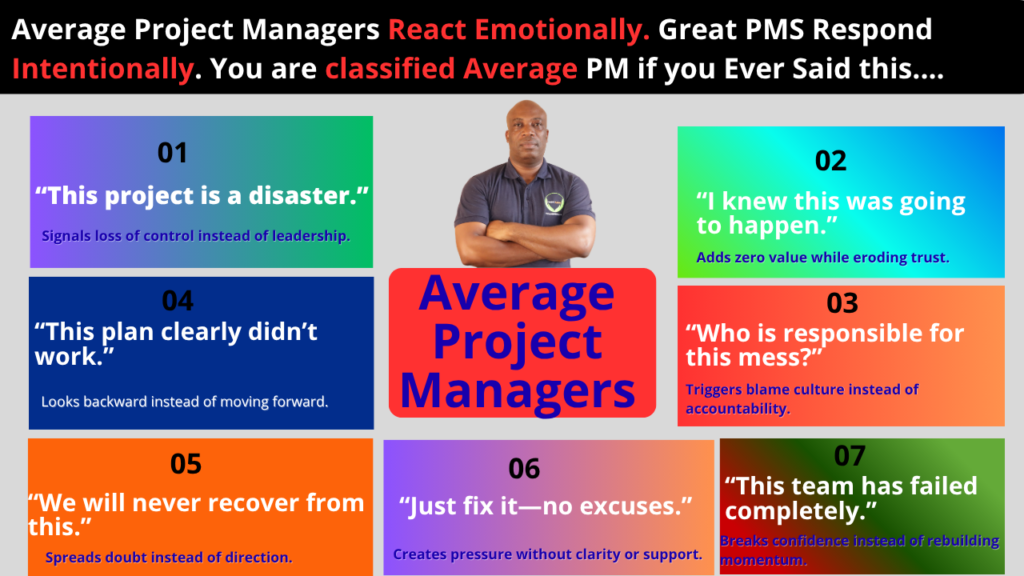
When you put all these phrases together, a pattern starts to show.
“This project is a disaster.”
“I knew this was going to happen.”
“Who is responsible for this mess?”
“This plan clearly didn’t work.”
“We will never recover from this.”
“This team has failed completely.”
On the surface, they may sound like ordinary reactions from someone under pressure. And to be fair, project pressure is real. Any Project Manager who has spent years in delivery knows that projects can test your patience, judgment, and emotional control. I have seen enough challenging project environments to know that frustration is part of the job. But these phrases reveal something deeper than frustration.
They reveal how a Project Manager thinks when things stop going according to plan.
That is the real issue.
An average Project Manager often speaks from emotion before speaking from leadership. You hear panic before analysis. Blame before accountability. Defeat before recovery. Judgment before diagnosis. The words may come out quickly, but they usually point to deeper weaknesses in leadership style.
The first weakness is emotional reactivity.
Instead of slowing down and assessing the situation, the average Project Manager reacts to the pressure in the room. When that happens, language becomes dramatic. The project becomes a disaster. The team becomes a failure. Recovery becomes impossible. That kind of language may reflect how the leader feels in the moment, but it does not help the team think clearly.
Conclusion
The difference between an average Project Manager and a great one is not always seen in a project plan, a status report, or a meeting agenda. Very often, it shows up in the words they choose when the pressure is on.
That is what these seven phrases really reveal.
They show whether a Project Manager brings panic or clarity. Whether they react with blame or lead with accountability. Whether they make the room heavier or help the team regain direction. And in real project life, that difference matters more than many people realise.
Over the years, one thing becomes very clear: projects do not remember us only for the tools we used or the meetings we chaired. People remember how we led when things became difficult. They remember whether we stayed calm, whether we created confidence, and whether we helped the team move forward when the situation was uncomfortable.
That is why communication is never a soft skill in project management. It is a leadership skill.
The words of a Project Manager can steady a team or unsettle it. They can build trust or damage it. They can create momentum or deepen frustration. In many cases, the language used in a difficult moment becomes the first signal of whether a project is about to recover or drift further into trouble.
A great Project Manager understands this. They do not speak just to express emotion. They speak to create direction.
Final Thoughts
If there is one lesson behind this entire discussion, it is this: pressure does not create leadership style, it reveals it.
Any Project Manager can sound composed when the project is on track, stakeholders are happy, and delivery is going smoothly. The real test comes when deadlines slip, issues escalate, and the team looks to leadership for answers. That is where the gap between average and great becomes obvious.
From my own experience in project environments, I have seen that strong leadership rarely means having perfect answers on the spot. More often, it means asking better questions, staying measured, and choosing language that helps people think clearly. That is what separates reaction from leadership.
FAQ
1. What is the difference between an average and a great Project Manager?
The difference often shows up in how they respond under pressure. An average Project Manager may react emotionally, blame others, or create panic. A great Project Manager stays calm, focuses on facts, and guides the team toward solutions.
2. Why does language matter so much in project management?
Language shapes how teams think and respond. The words used by a Project Manager can build confidence or create fear. In difficult moments, communication often determines whether a team stays focused or becomes discouraged.
3. Can a Project Manager be technically strong but still struggle as a leader?
Yes. A Project Manager may be good at schedules, reports, and coordination, but still fall short in leadership if they do not communicate well, take ownership, or handle pressure in a constructive way.
4. How can a Project Manager improve the way they speak during project pressure?
It starts with pausing before reacting. A good Project Manager learns to replace blame with analysis, panic with clarity, and frustration with direction. Better leadership language usually comes from self-awareness and practice.
5. Are these phrases always a sign of poor project management?
Not always on their own. Anyone can say the wrong thing in a stressful moment. The bigger issue is whether these phrases reflect a repeated pattern in how the Project Manager leads, communicates, and responds to setbacks.
6. What is one habit that can help a Project Manager become more effective?
One of the most valuable habits is learning to ask better questions in difficult moments. Instead of reacting emotionally, an effective Project Manager asks what happened, what the impact is, and what needs to happen next.