Introductions
Project management is one of those professions that many people think they understand — until they are given a real project with real pressure, real stakeholders, real budgets, real delays, real politics, and real consequences.
That is when the difference becomes clear.
Some project managers simply manage tasks. They follow up on activities, update schedules, chase status reports, attend meetings, and escalate when things go wrong.
But master project managers operate differently.
They do not only ask, “What is due this week?”
They ask-
- Why are we doing this project?
- What business value must it deliver?
- What could go wrong before it becomes visible?
- Who needs to be influenced for this project to succeed?
- What decision does leadership need from me right now?
- Which delivery approach best fits this environment?
- How do I make the system easier, smarter, and more sustainable?
That is the difference between an ordinary project manager and a master of the craft.
If you want to get more details, there is a full video here that delves deeper into this explaining these 8 traits of a project management mastermind. You can also start by improving your project management skills and leadership by downloading a free PM Skills checklist from here.
After years of working in project environments, I have learned that technical knowledge is important, but it is not enough. Certifications, templates, methodologies, and tools can help you start. But they do not automatically make you a great project manager.
The true difference is in the traits you develop.
Table of Contents
1. Strategic Thinking
Connecting the Project to the Bigger Picture of the Business or Organization.
A master project manager does not manage the project in isolation. They understand that every project exists for a reason. There is usually a business problem to solve, an opportunity to capture, a risk to reduce, a customer experience to improve, a regulatory requirement to meet, or a strategic objective to support.
This is where many project managers get stuck. They focus too much on deliverables and not enough on outcomes.
A deliverable is what the project produces.
An outcome is the change or value the organization expects after the deliverable is used.
For example, implementing a new system is not the true business outcome. The real outcome may be faster processing, better reporting, reduced errors, improved customer service, stronger compliance, or lower operating costs.
A master project manager keeps asking:
- How does this project support the organization’s goals?
- What value must be realized?
- What benefits are expected?
- What problem are we actually solving?
- How will success be measured after delivery?
This is strategic thinking. It moves the project manager from being a coordinator of tasks to a driver of business value.
2. Anticipation — Seeing Risks Before They Become Issues
One of the strongest traits of an elite project manager is anticipation.
Many project managers are good at reacting.
A problem happens, and they quickly organize meetings, chase updates, escalate to sponsors, and create action plans. That is useful, but it is not mastery. Mastery is seeing the problem before it becomes a problem.
A risk is something or event that may happen in the future and may negatively or positively affect the project’s objectives or goals
An issue is something that has already happened.
The master project manager understands this difference clearly. They do not wait for risks to mature into issues. They create space for the team to think ahead.
They ask:
- What could delay this work?
- What assumption are we making that may not be true?
- What dependency could fail?
- What decision is required now to avoid trouble later?
- What happens if we do nothing?
- What is the impact if this risk becomes real?
This is not negativity. This is professional foresight.
3. Executive Communication — Saying What Leaders Need to Hear.
One of the biggest growth areas for project managers is communication. Many project managers communicate in too much detail, especially when dealing with senior leadership.
They explain every technical discussion, every meeting outcome, every operational challenge, and every background activity. While the information may be accurate, it may not be useful at executive level.
Senior leaders usually want clarity.
They want to know:
- Are we on track?
- Are we within budget?
- What are the major risks?
- What decisions are needed?
- What support is required?
- What is the impact on business objectives?
- What happens if we delay the decision?
A master project manager adjusts communication based on the audience. The project team may need detailed task-level conversations.
The sponsor may need business impact, decision points, and escalations. The project board may need progress, risk exposure, tolerance status, and options. The customer may need reassurance, clarity, and agreed next steps.
Executive communication is not about hiding details. It is about presenting the right level of detail to the right audience at the right time.
That is a rare skill.
4. Influence Without Authority — Leading People Who Do Not Report to You

Project managers often have a difficult leadership challenge. They are responsible for delivery, but many of the people they depend on do not report to them directly.
Business users, technical specialists, vendors, executives, finance teams, procurement teams, legal teams, compliance teams, and operational teams may all be critical to delivery — but they may not be under the project manager’s formal authority.
This is where influence becomes essential.
A master project manager does not rely only on job title.
- They build trust.
- They understand people’s motivations.
- They communicate the importance of the work.
- They create alignment.
- They remove blockers.
- They know when to negotiate,
- They know when to escalate,
- They know when to persuade, and
- They know when to stand firm.
Influence without authority is one of the most important leadership skills in project management.
It is not manipulation.
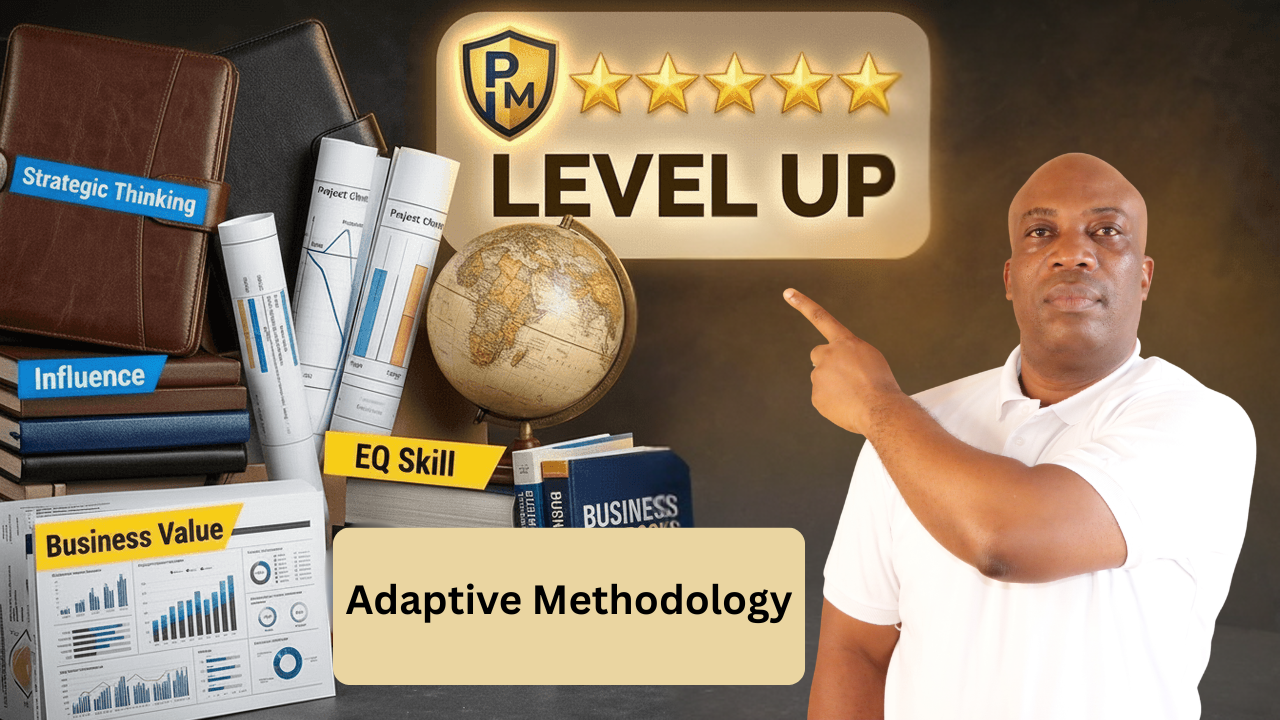
5. Adaptive Methodology — Choosing the Right Approach for the Work

A master project manager is not trapped by one methodology.
- They do not force every project into Agile.
- They do not force every project into Waterfall.
- They do not use Hybrid just because it sounds modern.
They study the environment and choose the delivery approach that fits the nature of the work. Some projects require a predictive approach because the sequence matters. Construction, infrastructure, regulatory implementation, and certain banking or enterprise system projects often need strong upfront planning, clear dependencies, controlled change, and structured governance.
Other projects benefit from an adaptive approach because the solution needs to evolve. Software products, digital platforms, customer-facing applications, and innovation projects may require iterative learning, feedback loops, and incremental delivery.
Some environments need a hybrid approach.
The master project manager asks:
- How clear are the requirements?
- How much change is expected?
- How risky is the delivery environment?
- How regulated is the project?
- How dependent are the work packages on each other?
- How quickly does the business need usable value?
- What governance model is required?
The goal is not to prove loyalty to a framework. The goal is to deliver value in the most appropriate way.
A methodology is a tool. A master project manager knows when and how to use the tool.
6. Business Acumen — Understanding Value, Cost, Benefits, and Impact
A project manager who does not understand business value will always be limited.
Project management is not only about scope, time, and cost. It is about helping the organization make smart investment decisions and realize meaningful benefits.
Business acumen means understanding concepts such as:
- Return on Investment
- Benefit realization
- Cost of delay
- Operational efficiency
- Revenue impact
- Customer value
- Total cost of ownership
A master project manager can explain why a project matters in business language.
- They can connect delivery progress to business consequences.
- They can challenge work that does not add value.
- They can help stakeholders understand trade-offs.
7. Innovation Mindset – Improving the Way Projects Are Delivered
A master project manager does not blindly repeat old ways of working.
They look for improvement. They innovate to remove friction, improve control, increase transparency, and support better decisions.
They ask:
- Can this process be simplified?
- Can this report be automated?
- Can this dashboard give better decision-making insight?
- Can we reduce manual follow-ups?
- Can lessons learned be captured earlier?
- Can the team collaborate better?
- Can technology help us deliver faster or with fewer errors?
Innovation in project management is not always about big transformation.
- Sometimes it is a better risk dashboard.
- Sometimes it is a clearer escalation process.
- Sometimes it is an improved project governance structure.
- Sometimes it is a better communication rhythm.
- Sometimes it is a custom project management information system that gives leadership real-time visibility.
The master project manager is always looking for ways to make delivery smarter. They do not innovate for the sake of looking modern.
8. Project Management Intelligence — Leading Across Different People, Teams, and Environments
PM Intelligence
Modern projects are rarely delivered by one type of person in one location with one way of thinking.
Project teams can include different cultures, countries, languages, time zones, work habits, leadership styles, and organizational backgrounds.
A master project manager understands this.
- They do not assume that everyone communicates the same way.
- They do not assume that silence means agreement.
- They do not assume that resistance means laziness.
- They do not assume that one leadership style works everywhere.
- They know cultural intelligence is the ability to lead diverse people with awareness, respect, and adaptability.
It means understanding how people make decisions, raise concerns, respond to conflict, interpret urgency, and engage with authority.
In global projects, project management intelligence can make the difference between alignment and confusion.
The master project manager creates an environment where people can contribute, challenge, clarify, and collaborate.
They lead with empathy, but they also maintain accountability. That balance is powerful.
My Final Thoughts — Mastery Is Built Through Practice, Not Titles
Becoming a master project manager is not about having the loudest voice in the room.
- It is not about having the most certifications.
- It is not about creating the most beautiful project plan.
- It is not about using the latest methodology or tool.
- It is about developing the judgement to lead projects through uncertainty.
- It is about connecting delivery to strategy.
- It is about anticipating problems before they damage the project.
- It is about communicating clearly with executives.
- It is about influencing people who do not report to you.
- It is about adapting your methodology to the situation.
- It is about understanding business value.
- It is about leading diverse teams with emotional and cultural intelligence.
- It is about building structures that help people deliver.
The ordinary project manager manages activities.
The master project manager creates alignment, protects value, enables decisions, and leads delivery with purpose.
That is the level every serious project manager should aim for.
Question for project professionals: Which of these traits do you believe separates a good project manager from a truly great one?
Frequently Asked Questions
What is the difference between a task manager and a Master PM?
A task manager focuses on checking off requirements, while a Master PM understands the strategic “why” and aligns project outcomes with business objectives.
Why is business acumen important for project managers?
It allows PMs to speak the language of stakeholders, focusing on ROI and ensuring the project delivers actual value to the organization.
What does ‘benefit realization’ mean?
Benefit realization is the process of ensuring that the intended improvements and value of a project are actually achieved after completion.
How can I improve my strategic thinking?
Start by asking how every project task contributes to the company’s long-term goals and study the financial impact of your project decisions.
What is the ‘Power of Anticipation’ in PM?
It is the ability to foresee risks and roadblocks before they happen, allowing the PM to mitigate issues proactively.
Is ROI only for finance teams?
No, elite PMs use ROI to justify project resources and demonstrate the success of their initiatives to leadership.
How do I move from checking boxes to leading?
Shift your focus from “what” needs to be done to “how” the project creates a competitive advantage for your organization.